

the problem with news
✨when meaning fails to surface ✨

I came across a recent story in The Wall Street Journal entitled “Six Friends Tried to Plan a Girls’ Trip in a Group Chat. Things Went Sideways.” The article garnered hysterical responses in Instagram's comments, on the absurdity of this article’s existence at all:
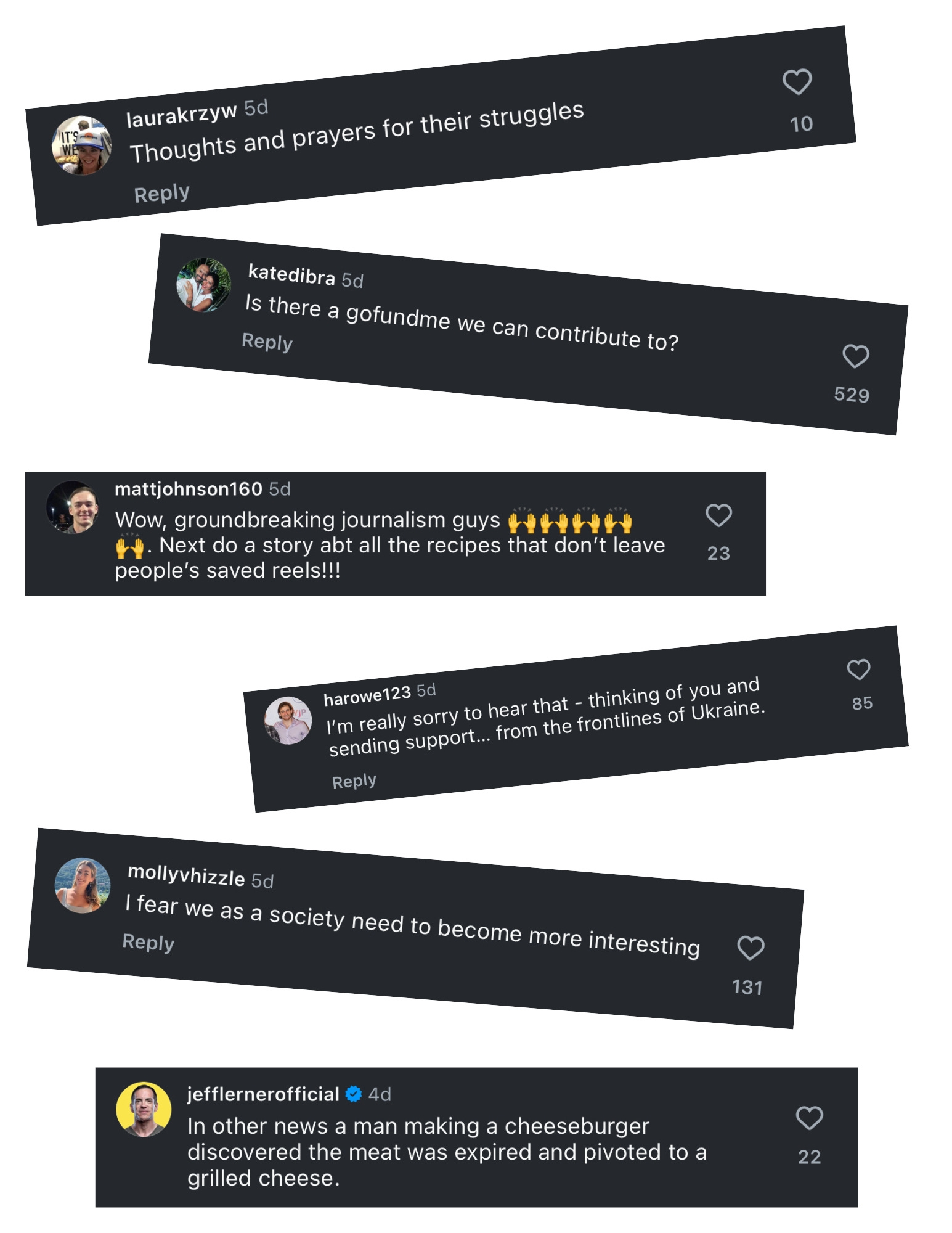
Essentially, the glaring sentiment was: THIS IS NOT NEWS.
People had hoped for true crime drama, or any kind of climax and resolution, but no. The article merely depicted an underwhelming account of an unresolved text thread of a group of women trying to plan a trip that caused division and hurt feelings.
The reporter impartially reported the facts, which gives the piece journalistic integrity. But because the facts were so shockingly banal, the article left readers questioning why this scenario even matters; and the 1,000+ disparaging comments reveal that searching for meaning in something as unremarkable as a dysfunctional group chat, is not what readers want.
The former high school English teacher in me recognized this classic plot-without-theme frustration. (Brief refresher: plot is what happens; theme is the deeper idea—aka, the plot’s meaning. An example: The plot of E.T. is that a spaceship of aliens leaves one alien behind on Earth, and that alien meets and befriends a boy. A theme from E.T. is the power of friendship and love across differences.) Bottomline, we all crave the fulfillment of deeper meaning in the stories we consume. And we particularly appreciate when meaning comes through the plot so naturally that we’re effortlessly moved to feel something of value. But when the plot line lacks intrigue and meaning—like with the failed group chat—we typically default to disappointment.
Some newsworthy plot lines are juicy enough to sustain our attention, whether or not the meaning shines through: a mysterious murder, a catastrophic natural disaster, a scandalous affair. But these shocking plot lines merely trick our systems because they activate big emotions, like shock, fear or horror. Our curiosity gets outwardly-focused about what happened to strangers. But unless the story is inwardly meaningful by somehow promoting reflection, or somehow connecting us to others in ways that matter, or somehow inspiring action through collective empathy, those juicy, newsworthy plot lines are simply our entertainment at someone else’s expense.
And that’s why I struggle with traditional news.
News, by design, seems like someone else's race to deliver as many devastating, plot-based facts as possible. And as a consumer, absorbing news can feel like being in a doomed blender of bad with ADHD; there seems to be minimal focus on how we might process all the devastating news. I’ve never been on the inside of a news organization, but according to Succession, ratings seem to drive the machine, and shocking headlines drive ratings. For all kinds of reasons that I’ll likely never know, news providers don’t seem motivated to help the audience connect our inner dots by getting us to reflect on: what does this mean for me? for you? and for us?
So although I concur that this failed-group-text-travel-thread is not WSJ newsworthy, I appreciate that it deviates from the overwhelming real-life horror that makes up much of today’s news cycle. And because I’m all about connecting inner dots, I’m keen to pick up where the article’s journalist left off by further exploring this ordinary plot line to see if it actually contains some worthwhile themes for us ever-becoming beings to consider.
Four themes come to mind:
1 | We easily overlook the most crucial element of a gathering when planning to gather. I’ve long subscribed to Priya Parker’s teachings in The Art of Gathering, and this group’s flailing attempts to gather reinforce the importance of Parker’s philosophy that when we are designing a gathering, we ought to start from the need, not the aesthetic.
So, in the case of the failed group chat, rather than focusing on the travel destination, which seems to be the only ground they attempted to cover, Parker suggests first focusing on the purpose of gathering at all. The article reported that their collective upcoming 50th birthdays was the impetus for the group’s gathering; Parker would argue that their shared birthdays is the plot, not the purpose.
Maybe the purpose for one of them is to have a much needed and relaxing break from the exhaustion of stay-at-home motherhood; maybe the purpose for another is to treat her senses to luxury, exotic cuisine and overfloweth beverages; maybe the purpose for another is to create an IG-worthy visual spread for her social media following; maybe the purpose for another is to settle into their friendships and go on long walks to catch up on life’s many ups and downs. Unless desired purpose is discussed, how would we know?
Maybe if they'd discussed their personal desires and needs for the gathering, they’d find common ground; or, maybe the reasons to not gather would clearly surface. But when we’re all over the place with our unspoken purposes, we struggle to launch; and even if we do eventually launch, because one mighty leader takes the reigns and makes the gathering happen, if we’re not on the same page with the purpose of the gathering, ultimately, disappointment tends to befall the group in some way—it’s inevitable. And rather than having a meaningful gathering that feeds positive transformation, that disjointed gathering could mark the beginning of a challenging fracture.
2 | The questions we ask matter. And that goes for the questions we ask others, and the questions we ask ourselves. After their 50th birthdays passed with no group trip, the article’s author wrote: “I asked all six women where things currently stand. I got six different answers.” I wonder what she may have learned if she’d asked: what do you want out of this gathering? Or, what do you think the other women want out of this gathering?
And we’d all benefit from regularly asking ourselves, in all kinds of scenarios: why does this matter for me? And that’s not to inspire unbalanced self-interest or entitlement; it’s more about checking in with one’s own emotional landscape, so that we can become more self-aware to effectively make decisions that better serve our well-being.
The three most effective questions that I’ve incorporated when making a tricky decision that affects and involves others are these: (1) What do I want for me? (2) What do I want for you? (3) What do I want for us? I gleaned this tool from a communications workshop called The Engaged Workshop that my husband and I took, and went on to co-lead. When all parties ask themselves, then articulate their responses to these three questions, effective decisions get made.
3 | Direct communication leads to cleaner outcomes. As a college freshman, I dreaded a difficult conversation that I needed to have with a roommate, which was to tell her that I’d decided to live with someone else for my sophomore year. My mom’s sage advice was this: you can have one uncomfortable conversation now to make way for a year of what you want; or, alternatively, you can avoid that hard conversation and endure a year of disappointment. I’ve applied her advice to ‘be direct sooner than later’ to countless situations since then. Direct communication prevents, addresses and resolves so much of the thorny tensions that comprise our complex emotional lives. And the women on the group chat could have saved time, effort and energy by directly discussing what they wanted and needed for themselves and each other.
It’s also worth noting that although texting reigns as a convenient form of communication in our daily lives, texting is inherently flawed when it comes to the emotional intricacies of human interaction. Conversations that could happen in minutes on a call can drag on for ages over text; one’s intended tone can be absent; humor can be misunderstood; sarcasm can be read as passive aggression; passive aggression can be read as humor; the implications of emojis vary. Text exchanges leave far too much room for indirect communication pit falls. My opinion is that texting wins for communicating logistics and straight-forward loving sentiments. When it comes to anything with nuance, pick up the phone.
4 | Friendships change, and that’s okay. Relationships from the past may not offer the fuel we need for one’s own fulfilling forward growth. And that may seem sad, but it doesn’t have to be. Maybe the group trip didn’t happen because as they’re each approaching 50, they’ve tuned into their inner knowing, and although they’ve loved these women historically and can imagine enjoying this group trip, perhaps gathering is not what the collective whole actually wants when it comes to investing today’s time, money and energy.
Every yes is a no to something else; and every no is a yes to something else. Perhaps this group of women are not even aware of each others’ yeses these days; a productive few questions that we all ought to be asking our dearest friends are: What are you saying ‘yes’ to these days? What yeses make you feel good?
Ultimately, I’d say that although this failed-group-text-travel-thread story isn’t newsworthy, it is thought-worthy. Perhaps the author, like me, believes that our everyday lives are filled with unremarkable moments that can offer valuable life-learning; but the key is digging for, and exposing, the meaning. This article missed the mark, first because the WSJ platform isn’t a match for this kind of interpersonal news, but mostly because the article didn’t help its readers uncover the plot’s meaning.
But luckily, we have Substack, a place where inner-dot-connecting writers live, and where thoughtful readers wonder. I’d love to hear your opinions on the state of news and what’s newsworthy or thought-worthy and why.
Let’s keep growing.
🌱
Other ways I can support your inner self today:
Cozy up with me and my dog for my most recent story — “the opening” — on Becoming Everwell with Linds.
Enroll in my FREE Masterclass: The 5-Step Framework to Thriving as a Midlife Mom. Or, take my QUIZ.
The Letter-Writing Retreat is designed for those wanting to connect and create in a meaningful way with others around the art of forever letter-writing. This NEW OFFERING isn’t yet on my website, but if you’d like to team up to create an inspired gathering with your desired group, let’s brainstorm, and figure out how to make it happen.
🌱